A New Era of Precision, Personalization & Prediction
In today's healthcare landscape, leaders face a dual mandate: deliver superior patient outcomes while ensuring operational efficiency and scalability. At this intersection, one technology is rapidly moving from concept to boardroom conversation—Digital Twins.
Born in aerospace and industrial engineering, digital twin technology is now reshaping healthcare. With the ability to simulate, predict, and optimize patient outcomes and hospital operations in real time, digital twins are no longer an experiment—they are a strategic lever for transformation.
From Engineering Marvels to Medical Miracles
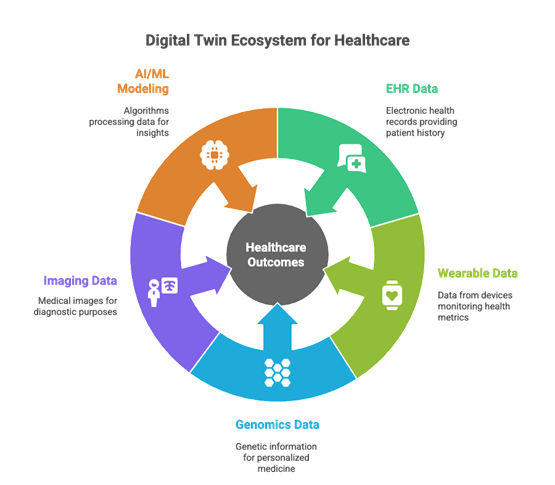
A digital twin is a dynamic, virtual replica of a physical entity. In healthcare, this entity could be an organ, a physiological system, or even the entire human body. What sets digital twins apart from traditional simulations is their ability to continuously update and adapt using real-time data streams—be it from wearables, electronic health records (EHRs), imaging tools, or lab reports. This creates a living, learning model of a patient that reflects their changing health status and can forecast what's likely to happen next.
As healthcare pivots toward a more proactive and preventive model, digital twins are emerging as the bridge between massive health data and actionable, individualized care.
Personalization at Scale: The Promise of Patient-Specific Twins
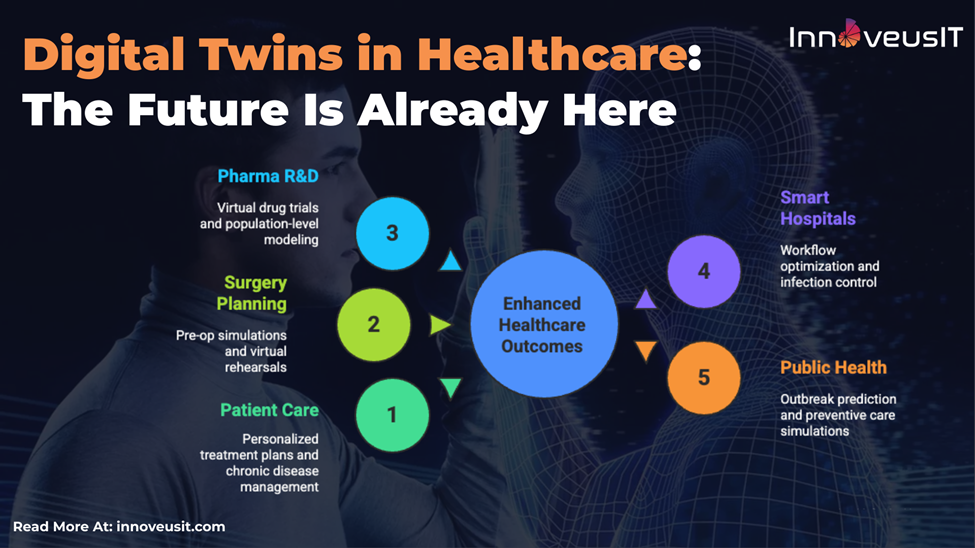
Imagine a cardiologist who can simulate how a patient's heart will respond to different medications—or a diabetic care team that can model glucose variations across different diet and exercise regimes. Digital twins make this possible. By integrating genomic, physiological, and lifestyle data, they enable hyper-personalized medicine where treatment plans are no longer generalized but customized to each patient's biology and behavior.
This is more than theoretical. A study at Mayo Clinic using digital twin models for diabetes management showed a 1.8% average drop in hemoglobin A1c levels over a year, and 89% of patients achieved target A1c levels under 7%. These aren't just better outcomes—they're measurable, impactful shifts in chronic disease control.
Reimagining Surgery: Precision Before the Scalpel
The impact of digital twins isn't limited to diagnosis and treatment—it's revolutionizing surgical planning. At Duke University and in leading Indian hospitals like SGPGI Lucknow, vascular and cardiac digital twins are helping surgeons simulate complex procedures in advance. These simulations factor in real-time anatomical and hemodynamic data, allowing teams to "rehearse" surgery digitally, select the optimal approach, and mitigate risk before a single incision is made.
Such use cases have already begun reducing surgical errors and improving recovery times, particularly in high-risk specialties like cardiothoracic and neurovascular surgery. The potential? Fewer surprises in the OR and more confident, data-backed decision-making.
This is not just clinical innovation—it's an enterprise risk management tool. For hospital executives, digital twin–driven simulations mean:
- Lower malpractice exposure
- Improved utilization of surgical resources
- Higher patient satisfaction scores
Beyond the Body: Operational Twins for Smart Hospitals
But digital twins aren't confined to the human body. Hospitals are deploying digital replicas of operational workflows, infrastructure, and supply chains to optimize resource allocation, patient flow, and emergency response. For example, hospital administrators can use these models to test how different staffing patterns impact patient wait times or how to route patients during a disease outbreak.
In this way, digital twins extend beyond clinical care into system-wide healthcare efficiency, making hospitals smarter, leaner, and more resilient in times of crisis.
Healthcare providers are also building operational digital twins—replicas of hospital workflows, supply chains, and emergency protocols. These are helping CXOs answer mission-critical questions:
- How will different staffing patterns impact wait times?
- What is the best routing plan during an outbreak?
- How can we balance cost, efficiency, and quality in real time?
The outcome: smarter, leaner, more resilient hospitals.
Simulating What's Next: From Drug Trials to Disease Prevention
Pharmaceutical companies are also leaning into this technology. By creating population-level digital twin "banks," researchers can simulate how new drugs might affect various genotypes, comorbidities, or environmental exposures—without the need for physical trials in the early stages. This can accelerate development timelines, reduce costs, and eliminate safety concerns before going into live testing.
Similarly, public health teams are beginning to use digital twins to predict disease outbreaks, track lifestyle-related health deterioration, and prevent complications before they escalate—shifting healthcare from reactive to truly preventive.
Pharma companies and public health teams are embracing digital twins to:
- Accelerate drug discovery by simulating population-level responses
- Cut trial costs & risks by testing interventions virtually before human trials
- Predict and prevent outbreaks, enabling proactive care at scale
For CIOs and data leaders, this highlights the need for advanced AI/ML pipelines, secure cloud infrastructure, and interoperable platforms that can support large-scale simulations.
Global Momentum: From Research Labs to Real Hospitals
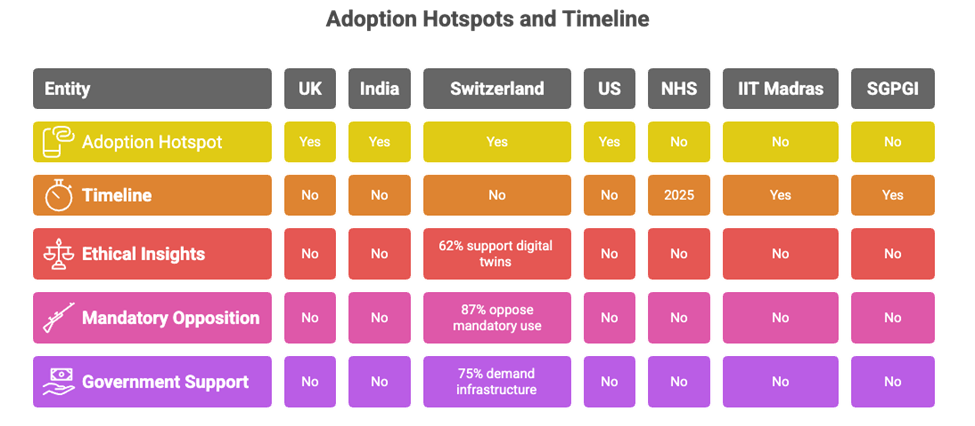
The momentum is global. In the U.K., the NHS has launched a five-year study on digital heart twins for patients with pulmonary arterial hypertension (PAH), using wearable devices and imaging to model heart behavior over time. Meanwhile, in India, institutions like IIT Madras and SGPGI are spearheading efforts to embed digital twins in day-to-day clinical workflows—especially for complex interventions that demand high precision.
This isn't isolated innovation. According to Grand View Research, the healthcare digital twin market was valued at USD 902.6 million in 2024, and is expected to grow to USD 3.55 billion by 2030, with a compound annual growth rate of 25.9%. Another estimate pegs the market even higher—reaching USD 21.1 billion by 2028.
Societal and Ethical Dimensions
As digital twins move from research to routine care, questions of equity, access, and ethics grow louder. A 2025 study in Switzerland revealed that while 62% of people support digital twins for healthcare, a large majority—87%—oppose making them mandatory, and 75% believe governments should support the necessary infrastructure.
These findings underscore a central truth: for digital twins to fulfill their promise, they must be inclusive, regulated, and grounded in trust. Otherwise, they risk widening health disparities between those with access to technology and those without.
Challenges on the Road Ahead
Despite the promise, hurdles remain. First, data security and patient privacy must be rigorously protected, especially given the sensitive nature of real-time biometric data. Second, integrating multiple data sources—imaging, wearables, genomics—into a coherent and interoperable platform remains technically complex.
Third, healthcare systems must overcome organizational and regulatory inertia to adopt these tools at scale. Training clinicians, aligning reimbursement models, and navigating evolving legal frameworks will all take time—and cross-disciplinary cooperation.
The Future Is (Virtually) Human
Despite the challenges, one thing is clear: digital twins are no longer a futuristic concept. They are a powerful, present-day tool that's transforming healthcare from the inside out—from patient care to operational planning to population health.
With careful stewardship and ethical design, they could redefine how we treat disease, manage hospitals, and keep populations healthy. Whether it's a diabetic patient fine-tuning their insulin or a surgeon simulating a heart bypass, digital twins offer a new frontier in precision, personalization, and preparedness.
The human body has long been seen as too complex to predict. Now, with a digital twin, it doesn't have to be.
Key Takeaway for CXOs & Technology Leaders
Digital twins are not futuristic—they are operational today. They represent a strategic pivot point in healthcare transformation:
- For CIOs: Data integration, interoperability, and AI adoption will be decisive.
- For CXOs: Digital twins will determine competitive positioning, risk mitigation, and growth models.
- For Chief Architects: This is a call to design flexible, scalable platforms that enable continuous learning systems.
🏥 Ready to Transform Healthcare with Digital Twins?
Contact InnoveusIT at info@innoveusit.com or visit www.innoveusit.com to get started.