The enterprise IT services industry is entering a structural reset. For decades, pricing models have been anchored in human effort, full-time equivalents (FTEs), time-and-materials (T&M), and software seat licenses. These models worked because value creation was directly tied to human productivity.
That assumption is now breaking.
As AI agents move from pilots to production environments, enterprises are no longer buying effort, they are buying outcomes delivered through autonomous or semi-autonomous systems. This shift is not incremental. It fundamentally challenges how IT services are priced, governed, and scaled.
The future of IT services pricing will not be human-centric. It will be agent-centric.
________________________________________
Why Traditional Pricing Models Are Failing
Legacy pricing structures are misaligned with how modern digital work gets done. In an agent-driven environment:
- A single autonomous agent can replace multiple FTEs
- Work is executed continuously, not in billable hours
- Output is measured in decisions, actions, and outcomes-not effort
This creates a disconnect. Enterprises paying for “hours worked” or “resources deployed” are no longer accurately capturing value delivered.
The result?
Rising costs without proportional business impact or conversely, vendors underpricing highly valuable AI-driven outcomes.
This is why organizations are now actively exploring agent-based pricing frameworks that align cost with real business value.
| Dimension | Legacy FTE/T&M Model | Agent-Based Model |
|---|---|---|
| Unit of Value | Hours worked / headcount deployed | Outcomes delivered / decisions made |
| Scalability | Linear (add headcount) | Exponential (replicate agents) |
| Cost Predictability | Predictable but fixed-cost heavy | Variable, tied to consumption or outcome |
| Operational Hours | 8–10 hrs/day (human constraints) | 24/7 continuous operation |
| Pricing Driver | Input effort (FTE rate x hours) | Output quality x volume x tier |
| Governance | SLAs on uptime / delivery time | SLAs on accuracy, auditability, outcomes |
________________________________________
The New Pricing Paradigms for Agent-Based IT Services
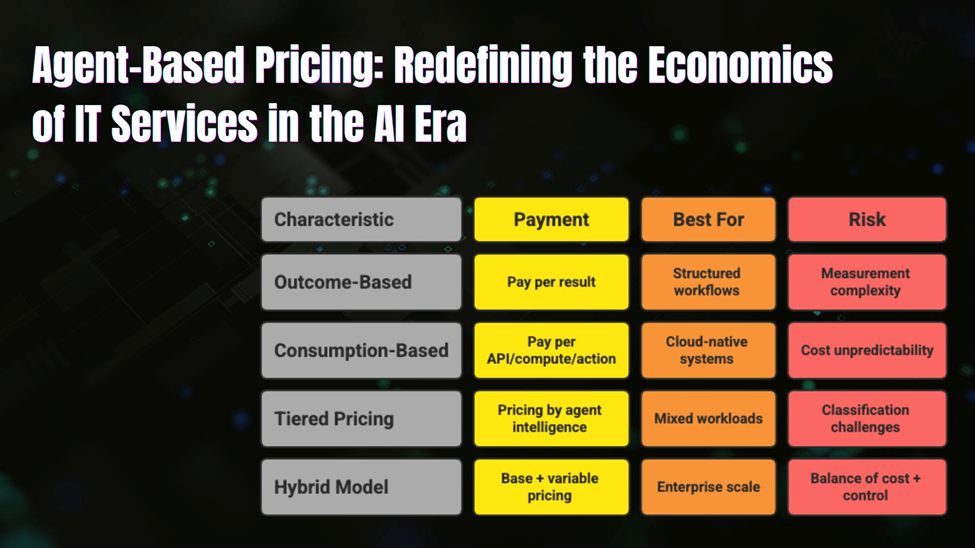
Forward-looking enterprises are adopting four emerging pricing models to better align economics with AI-driven delivery.
1. Outcome-Based Pricing: Paying for Results
In this model, enterprises pay based on measurable outcomes such as tickets resolved, workflows automated, or decisions executed.
This approach is powerful because it directly ties cost to business impact. If an AI agent resolves 10,000 support tickets autonomously, pricing reflects that outcome not the underlying compute or effort.
As highlighted in the advisory note, this model works best in well-defined, measurable workflows where outputs are clearly quantifiable.
However, it introduces challenges around accountability and measurement especially when outcomes are influenced by multiple systems and stakeholders.
Technical Calculation
Total Cost = (Outcomes Delivered) x (Price per Outcome Unit)
Where each Outcome Unit is a verified, system-logged completion event (e.g. ticket resolved, invoice processed, alert triaged)
Example — IT Support Automation:
| Parameter | Value |
|---|---|
| Monthly tickets resolved by AI agent | 10,000 |
| Price per resolved ticket (negotiated) | $2.50 |
| Human agent cost equivalent (fully loaded) | $12.00 per ticket |
| Agent Monthly Cost | 10,000 x $2.50 = $25,000 |
| Legacy Human Cost Equivalent | 10,000 x $12.00 = $120,000 |
| Net Monthly Savings | $95,000 (79% cost reduction) |
CTO RISK FLAG: Outcome-Based Pricing
Ensure your contract defines 'outcome' with precision. Ambiguous definitions (e.g. ‘ticket resolved’ without quality thresholds) expose you to gaming.
Require:
(1) machine-logged completion events with immutable audit trail,
(2) outcome quality SLA (e.g. customer satisfaction score ≥ 80%),
(3) dispute arbitration mechanism within 30 days.
________________________________________
2. Consumption-Based Pricing: The Cloud Analogy
This model mirrors cloud economics paying per API call, compute usage, or agent action.
It offers flexibility and scalability, particularly for cloud-native enterprises running dynamic workloads. Organizations can scale usage up or down without long-term commitments.
But there is a trade-off.
Consumption-based models can quickly become unpredictable at scale. Without strong governance and FinOps discipline, enterprises risk cost overruns, especially when autonomous agents operate continuously.
Technical Calculation
Monthly Bill = Σ [ (Action_i Volume) x (Unit Price_i) ] + Overage Fees
Sum across all billable action types i (API calls, LLM tokens, tool executions, DB reads/writes)
Example — Intelligent Document Processing Agent:
| Action Type | Monthly Volume | Unit Price | Subtotal |
|---|---|---|---|
| Document parse (OCR + extraction) | 500,000 pages | $0.004 / page | $2,000 |
| LLM inference calls (classification) | 1,200,000 calls | $0.0008 / call | $960 |
| Validation rule executions | 800,000 events | $0.0002 / event | $160 |
| Human-in-loop escalations (5%) | 25,000 cases | $0.50 / case | $12,500 |
| Platform base fee (included) | — | — | $3,000 |
| Total Monthly Cost | $18,620 |
FinOps Alert Threshold Formula:
Daily Spend Limit = (Monthly Budget) / 30 Alert at 80% of Daily Limit Auto-throttle at 95% of Daily Limit
Implement this governance layer in your FinOps tooling (CloudHealth, Apptio, or custom dashboards) to prevent agent cost sprawl
ARCHITECT’S NOTE: Consumption Governance
Autonomous agents operating in multi-step reasoning loops can trigger exponential token consumption. Implement hard rate limits at the orchestration layer, not just at the billing layer.
________________________________________
3. Tiered Agent Pricing: Pricing by Intelligence
Not all AI agents are equal.
A key insight from the advisory is the classification of agents into three tiers:
| Tier | Agent Type | Capabilities | Typical Monthly Price Range | Example Use Cases |
|---|---|---|---|---|
| Tier 1 | Task Agent | Single-step, deterministic actions. No reasoning. Rule-based execution. | $500–$2,000 / agent | Data retrieval, scheduling, notifications, form filling |
| Tier 2 | Reasoning Agent | Multi-step reasoning. Summarization, analysis, decision support. Tool use. | $2,000–$8,000 / agent | Code review, RCA analysis, document summarization, alert triage |
| Tier 3 | Autonomous Agent | End-to-end process ownership. Multi-agent orchestration. Self-directed planning. | $8,000–$30,000+ / agent | Incident response, autonomous procurement, contract negotiation support |
Pricing increases with the level of intelligence, autonomy, and business impact.
This model is particularly effective in mixed workload environments, where enterprises deploy a combination of simple and advanced agents across functions.
Technical Calculation — Mixed Agent Fleet:
Fleet Cost = (n1 x P1) + (n2 x P2) + (n3 x P3) + Platform Fee Where: n1, n2, n3 = number of agents at each tier P1, P2, P3 = per-agent monthly price at each tier
Apply volume discount tiers when n_total > 50 agents (typically 10–25% discount brackets)
Example — Enterprise IT Operations (500-employee org):
| Agent Tier | Count | Monthly Price | Monthly Cost |
|---|---|---|---|
| Tier 1 (Task Agents) | 15 agents | $1,200 / agent | $18,000 |
| Tier 2 (Reasoning Agents) | 8 agents | $5,000 / agent | $40,000 |
| Tier 3 (Autonomous Agents) | 3 agents | $15,000 / agent | $45,000 |
| Platform + Governance Fee | — | — | $8,000 |
| Volume Discount (15%) | — | — | -$15,450 |
| Total Monthly Fleet Cost | $95,550 |
FTE Equivalent Comparison: A 26-agent fleet (as above) replacing equivalent human functions at a blended $90K fully-loaded annual rate = $234,000/month in human cost. Agent fleet cost = $95,550/month. Efficiency gain: 59%.
________________________________________
4. Hybrid Pricing: The Enterprise-Scale Standard
The most practical and scalable approach—and the recommended model for large enterprises is a hybrid structure.
This combines:
- A base retainer for platform access, infrastructure, and governance
- A variable component tied to usage, agent tier, or outcomes delivered
As the advisory clearly recommends, this hybrid model balances cost predictability with performance accountability, making it ideal for organizations with 500+ employees and ongoing engagements.
It reflects a deeper truth: enterprises need both stability and flexibility in an AI-driven operating model.
Technical Calculation
Total Monthly Cost = Base Retainer + Variable Component Where: Base Retainer = Platform fee + SLA coverage + governance tooling Variable Component = MAX( Consumption charges, Outcome-based charges ) x Tier multiplier - Volume discount
The MAX() function ensures vendor captures value regardless of which pricing lever dominates in a given month
| Component | Basis | Monthly Cost |
|---|---|---|
| Base Retainer | Platform + infrastructure + 99.9% SLA | $25,000 |
| Tier 1 agents (20) | Task agents @ $1,000 | $20,000 |
| Tier 2 agents (10) | Reasoning agents @ $4,500 (volume tier) | $45,000 |
| Tier 3 agents (4) | Autonomous agents @ $12,000 (volume tier) | $48,000 |
| Outcome bonus (above baseline) | Outcomes > 95% accuracy threshold | $8,000 |
| Overage consumption | Peak month burst (document processing) | $4,200 |
| Gross Total | $150,200 | |
| Volume discount (20%) | Contract > 12 months + 34 agents | -$27,640 |
| Net Monthly Total | $122,560 |
This hybrid model - base + variable — is the recommended framework for organizations with 500+ employees and multi-year AI vendor engagements. It balances cost predictability with performance accountability.
________________________________________
Technical TCO Framework for IT Leaders
For CTOs and IT architects, agent pricing is only one layer of total cost. A complete TCO analysis must account for five cost dimensions:
| TCO Dimension | Components | Estimation Method |
|---|---|---|
| 1. Licensing / Pricing | Agent tier fees, platform retainer, consumption charges | Use formulas in Section 2 above |
| 2. Integration Cost | API gateway, auth, middleware, data pipeline engineering | One-time: 2–4x monthly license; Ongoing: 0.5x monthly |
| 3. Governance & Observability | Logging, audit trails, explainability tooling, FinOps dashboards | 10–15% of annual license cost |
| 4. Security & Compliance | Data residency, access control, penetration testing, audit readiness | 8–12% of annual license cost |
| 5. Human Oversight (HITL) | Supervisory FTEs for escalation handling, model monitoring | 5–10% of FTE cost displaced by agents |
3-Year TCO = 36 x Monthly License + Integration Cost (one-time) + 36 x (Governance + Security monthly) + 36 x HITL Oversight Cost - 36 x (FTE cost displaced) - 36 x (Productivity gains monetized)
A positive ROI requires the displacement + productivity gain terms to exceed all cost terms over the 3-year horizon
Beyond Pricing: The New Negotiation Battleground
Agent-based pricing is not just a financial discussion, it is a governance and risk conversation.
As AI agents take on decision-making roles, enterprises must rethink vendor contracts and accountability structures.
1. SLA and Accountability
Who is responsible when an AI agent makes a wrong decision?
Traditional SLAs were built around system uptime and response times. Now, they must extend to decision accuracy and business impact.
| SLA Dimension | Legacy Definition | Agent-Era Definition | Target KPI |
|---|---|---|---|
| Availability | System uptime ≥ 99.9% | Agent response availability ≥ 99.9% | < 5 min MTTR |
| Accuracy | Not defined | Decision accuracy ≥ specified threshold | ≥ 95% (tier 2/3) |
| Latency | API response < 500ms | End-to-end task completion < SLA ceiling | Per-workflow target |
| Auditability | Log retention 90 days | Full reasoning trace, immutable, 7-year retention | 100% traceability |
| Escalation | Human response in 4h | Auto-escalation trigger + HITL handoff < 2 min | < 2 min P1 |
________________________________________
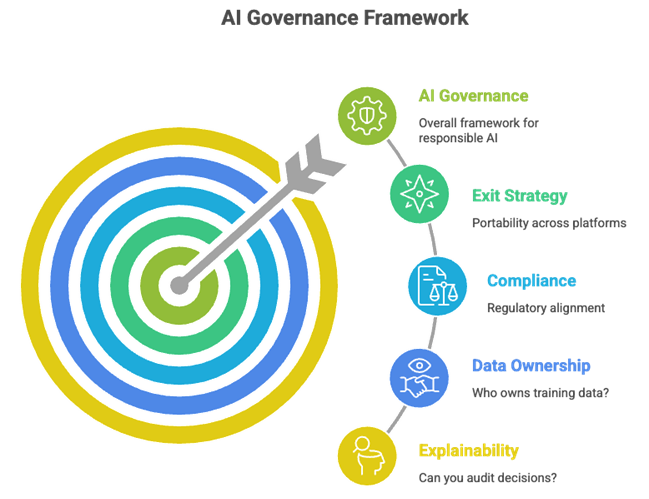
2. Auditability and Explainability
Enterprises must retain the ability to:
- Inspect how decisions are made
- Trace outputs back to inputs
- Validate reasoning logic
Without explainability, AI-driven systems become black boxes-introducing operational and regulatory risk.
Three non-negotiables must be contractually enforced:
- Decision Traceability: Every agent action must log inputs → reasoning → output with timestamp and model version
- Data Sovereignty: Contractual guarantee that enterprise data is not used in vendor model training without explicit written consent
- Exit & Portability: Agent workflow definitions, training data, and model weights (if fine-tuned) remain enterprise property with 90-day migration support
________________________________________
3. Data Sovereignty and Ownership
AI agents are only as powerful as the data they learn from.
Organizations must ensure:
- Their data is not used to train external models without consent
- Sensitive information remains within defined boundaries
- Compliance requirements are strictly enforced
________________________________________
4. Exit and Portability
The AI vendor landscape is evolving rapidly.
Enterprises need the flexibility to:
- Transition between platforms
- Migrate agent workflows
- Avoid long-term vendor lock-in
Exit clauses are no longer optional, they are strategic safeguards.
________________________________________
Agent-Based Pricing Calculation Cheat Sheet
A quick-reference summary of all pricing formulas for CTOs and IT procurement teams:
FORMULA QUICK REFERENCE
Outcome-Based:
Cost = Outcomes_Delivered x Price_Per_Outcome
Consumption-Based:
Cost = Σ(Volume_i x UnitPrice_i) + Platform_Fee
Tiered Fleet:
Cost = (n1xP1) + (n2xP2) + (n3xP3) + Platform_Fee - Volume_Discount
Hybrid Model:
Cost = Base_Retainer + MAX(Consumption, Outcome) x Tier_Multiplier – Discount
3-Year TCO:
TCO = 36x(License + Governance + Security + HITL) + Integration - 36x(FTE + Productivity gains)
The Strategic Shift: From Labor Arbitrage to Value Engineering
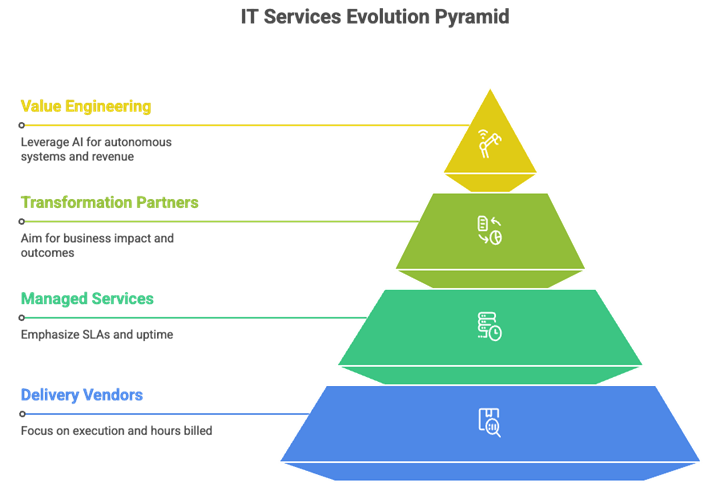
At its core, agent-based pricing signals the end of labor arbitrage as the dominant business model in IT services.
The new competitive advantage lies in:
- Designing intelligent agent ecosystems
- Orchestrating workflows across humans and machines
- Delivering measurable business outcomes at scale
This transforms IT service providers from “delivery vendors” into value engineering partners.
Enterprises, in turn, must evolve how they evaluate partners—not by headcount or rates, but by outcome velocity, automation maturity, and decision intelligence.
| Old Evaluation Criterion | New Evaluation Criterion |
|---|---|
| FTE count & location | Agent fleet sophistication & tier distribution |
| Blended hourly rate | Cost-per-outcome & efficiency ratio |
| SLA uptime % | Decision accuracy & escalation rate |
| Resource ramp time | Agent deployment velocity |
| Offshore leverage | Autonomy level & HITL ratio |
________________________________________
What CIOs and CFOs Must Do Next
To successfully transition to agent-based pricing, enterprise leaders should take three immediate steps:
1. Identify High-Impact Use Cases
Focus on workflows that are repetitive, measurable, and scalable—ideal candidates for outcome-based or hybrid pricing.
| Workflow Characteristic | Recommended Pricing Model |
|---|---|
| High volume, well-defined outcomes (e.g. support tickets) | Outcome-Based |
| Bursty, unpredictable volume (e.g. document processing) | Consumption-Based |
| Mixed complexity agents across departments | Tiered Agent |
| Long-term, enterprise-wide AI transformation | Hybrid (recommended) |
2. Build Cost Governance Frameworks
Implement FinOps-like discipline for AI agents—tracking usage, optimizing performance, and preventing cost sprawl.
- Implement spend dashboards with daily/weekly alert thresholds
- Assign agent cost ownership to product/line-of-business teams (not just IT)
- Track cost-per-outcome monthly and benchmark against FTE equivalent
- Set auto-throttle rules at 95% of monthly budget ceiling
3. Redesign Vendor Contracts
Move beyond traditional SLAs to include accountability for outcomes, explainability, and data governance.
- Move beyond uptime SLAs - mandate decision accuracy, auditability, and outcome accountability
- Require immutable audit trails with 7-year retention for regulated industries
- Negotiate exit clauses with 90-day data portability and workflow migration support
- Include data sovereignty guarantees: no training on enterprise data without written consent
________________________________________
The Bottom Line
Agent-based pricing is not just a new way to charge for AI. It is a new way to understand the economics of enterprise work.
As AI agents become embedded in technology and operations, pricing must evolve to reflect:
- Outcomes instead of effort alone
- Digital labor instead of only headcount
- Intelligence and autonomy instead of hours consumed
- Governance and control instead of unmanaged automation
- Measurable business value instead of raw activity
Organizations that adapt early will build a structural advantage. They will be better positioned to align cost with value, scale automation responsibly, and create faster innovation cycles with stronger economic discipline.
Those that do not may remain trapped in pricing models built for an earlier era of delivery.
The shift is already underway.
The question is no longer whether agent-based pricing will become a mainstream enterprise model.
The real question is which organizations will develop the technical, commercial, and governance maturity to lead in that future.
What pricing model do you believe will become the enterprise standard for agentic AI: outcome-based, consumption-based, tiered, or hybrid?