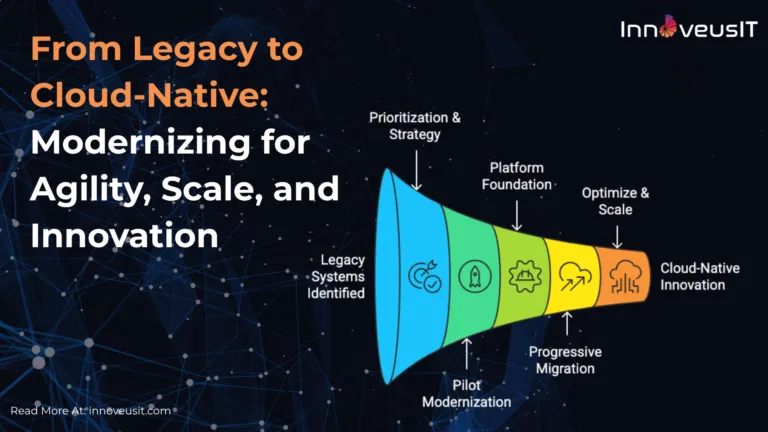
In a world that's increasingly digital-first, legacy systems often stand as silent barriers to innovation. These monolithic platforms, once the backbone of enterprise operations, now struggle to keep pace with the demands of modern scalability, agility, and speed. Businesses that once thrived on stable legacy environments are now finding that maintaining them is both costly and unsustainable.
The digital era doesn't just reward innovation—it demands it. For most organizations, modernizing to cloud-native architectures is the most strategic path forward.
The Modernization Imperative
Today's enterprises compete on speed—of feature delivery, customer experience, and data-driven decisions. But legacy systems built decades ago are ill-equipped for:
- API-first integrations
- Multi-channel user experiences
- Real-time data analytics
- Dynamic scaling
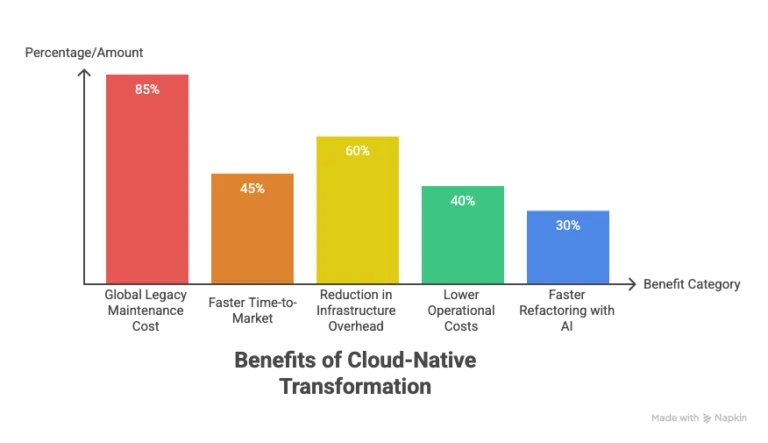
According to IDC, 73% of CIOs admit that legacy systems are a major drag on innovation, while Gartner estimates over $85B annually is spent globally to keep these systems afloat—resources that could be redirected to innovation.
Modernization is not a trend. It's a strategic imperative—anchored in business survival and technology relevance.
Why Cloud-Native?
Cloud-native doesn't just mean running on the cloud—it means building for the cloud using modern patterns to unlock flexibility, resilience, and real-time scalability:
- Microservices architecture (e.g., Spring Boot, .NET Core)
- Container orchestration (e.g., Kubernetes, OpenShift)
- Infrastructure as Code (e.g., Terraform, Pulumi)
- DevSecOps pipelines (CI/CD + security gates)
- API gateways and service mesh (e.g., Istio, Kong)
This transformation enables enterprises to:
- Break down large, rigid systems into independent services that evolve quickly.
- Scale elastically, ensuring performance during traffic spikes or rapid growth.
- Deploy features faster with continuous integration and delivery (CI/CD).
- Embed security and observability directly into the application lifecycle.
A McKinsey study reports that organizations adopting a cloud-native approach experience a 45% faster time-to-market and 60% lower infrastructure overhead, proving that modernization isn't just technical; it's strategic.
Different Paths, Same Destination
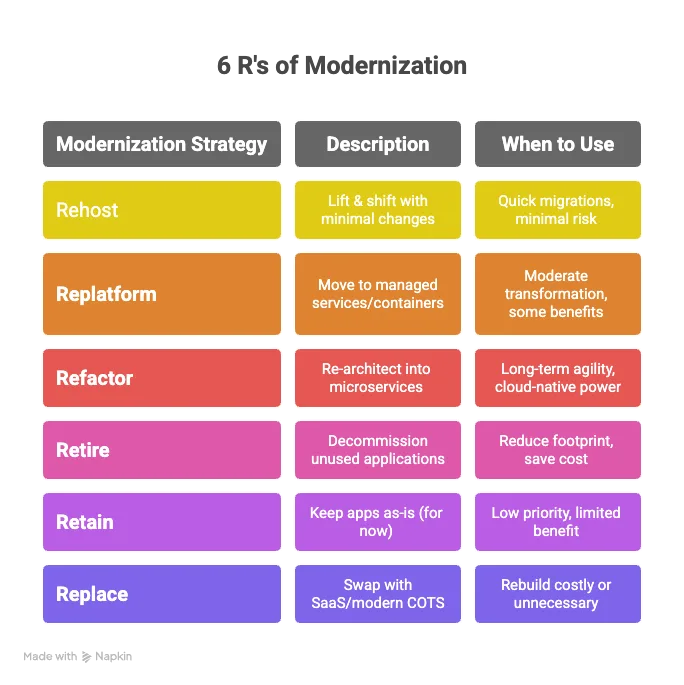
Modernization is not a one-size-fits-all journey. Enterprises often choose among three primary approaches depending on urgency, business goals, and legacy complexity:
Lift & Shift
This approach moves applications to the cloud "as-is," offering speed with minimal code changes. It's ideal for reducing infrastructure costs quickly but doesn't unlock the full benefits of the cloud.
Replatforming
This strategy modifies parts of the application (like moving databases to managed services) to leverage native cloud capabilities while keeping the core architecture intact. It balances effort and payoff.
Refactoring or Rearchitecting
The most intensive yet rewarding route, refactoring involves rewriting applications as modular microservices. It enables complete cloud-native functionality—ideal for organizations seeking long-term agility and innovation.
Selecting the right approach often begins with an application assessment that weighs cost, risk, and business impact.
What Makes Modernization Difficult
Despite the clear benefits, modernization isn't without its challenges. Legacy systems are often deeply embedded in critical operations and have decades of dependencies. Modernizing without disrupting these functions requires careful orchestration.
One common hurdle is complex interdependencies—applications that rely on outdated databases, custom logic, or hardcoded workflows. Automated discovery and assessment tools like Azure Migrate or CAST Highlight help teams map dependencies and prioritize which applications to migrate, retire, or refactor.
Another challenge is regulatory compliance and data security. Legacy systems often lack proper controls for modern cybersecurity threats or compliance mandates like GDPR, HIPAA, or ISO 27001. Embedding shift-left security—the practice of incorporating security testing early in development—and leveraging cloud-native identity, access, and encryption tools are key mitigation steps.
Lastly, many organizations face a cloud skills gap. Legacy-era developers and IT staff often lack hands-on experience with Kubernetes, Terraform, or container orchestration. Upskilling through certifications or partnering with experienced modernization teams can bridge this gap effectively.
Emerging Tools Accelerating the Shift
As cloud platforms and tooling ecosystems mature, modernization is becoming faster, safer, and more intelligent. Recent advances are helping organizations overcome traditional barriers.
For example, AI-driven refactoring tools like IBM's Mono2Micro and AWS CodeWhisperer can now analyze monolithic codebases and suggest optimal modular microservice designs. These tools reduce refactoring time by 30–50% and help minimize errors in translation.
Serverless computing is also gaining momentum. Platforms like AWS Lambda and Azure Functions allow businesses to build event-driven, scalable applications without managing any server infrastructure—ideal for lightweight, highly responsive workloads.
And with the rise of service mesh technologies like Istio and observability platforms like OpenTelemetry, teams can now manage microservice performance, security, and networking with precision—even across multi-cloud environments.
From Vision to Value: A Case Study
Consider a mid-sized financial services company burdened by a legacy loan origination system. Response times were slow, integration with digital channels was limited, and scaling to peak traffic was cost-prohibitive.
By partnering with a cloud modernization team, they embarked on a refactoring journey—rebuilding the application as a microservices-based, containerized platform on Azure Kubernetes Service (AKS). Leveraging CI/CD pipelines and Infrastructure-as-Code (IaC), they achieved:
- 2x faster loan approval turnaround
- 99% system uptime
- 40% reduction in operating cost
This wasn't just a technical upgrade—it was a business transformation.
A Strategic Roadmap to Cloud-Native Modernization
To succeed in modernization, organizations must treat it as a strategic, phased transformation—not a one-time migration.
Here's a practical 4-stage roadmap:
1. Assess & Prioritize
Inventory applications, evaluate business value, and identify modernization candidates. Use scoring models to rank apps based on ROI potential and complexity.
2. Choose the Right Strategy
Apply the 6 R's: Rehost, Replatform, Refactor, Retire, Retain, Replace. Not every application needs a rebuild; choose battles wisely.
3. Pilot and Prove Value
Run a modernization pilot with measurable outcomes. Use it to validate tooling, pipelines, and team processes before scaling further.
4. Scale with DevSecOps & Governance
Automate infrastructure, security testing, monitoring, and deployments. Build a platform engineering team to standardize modernization at scale.
Conclusion: Modernize Today to Compete Tomorrow
The future belongs to businesses that can adapt fast, innovate continuously, and scale effortlessly. Cloud-native modernization unlocks all three—but only for those ready to rethink legacy assumptions and embrace the cloud as a strategic platform, not just a hosting environment.
Enterprises that modernize gain more than operational efficiency—they gain competitive advantage. And as market pressures intensify, that advantage becomes mission-critical.
InnoveusIT: Your Strategic Partner for Cloud-Native Transformation
At InnoveusIT, we specialize in guiding businesses through every phase of modernization. From cloud readiness assessments to refactoring architectures, from building DevSecOps pipelines to optimizing cloud operations—we bring deep expertise and a proven track record of transforming legacy into future-ready platforms.
Whether you're migrating a monolithic ERP, rearchitecting a customer portal, or scaling AI workloads on Kubernetes, we ensure you unlock the full value of cloud-native innovation—without disruption, delay, or detours.
Also, to ensure not make common mistakes in Modernization Projects:
- Lifting monoliths "as-is" without dependency analysis
- Underestimating change management or the skills gap
- Ignoring post-migration FinOps and cloud governance
📩 Let's build your modernization roadmap—together.
Reach out to us at info@innoveusit.com